
The SPX has tended to strongly outperform in the coming month
Everything is getting more expensive these days and that includes S&P 500 Index (SPX) options. On Monday, the CBOE Volatility Index (VIX) closed above 20 for the first time since July. A higher VIX means option buyers are paying more for SPX options. Since these options are often used to hedge portfolios, it means investors are willing to pay more for protection against a downturn in stocks. This is why the VIX is referred to as a "fear gauge."
In this article, I’m looking at historical instances of the VIX closing above 20 for the first time in a while. I’ll look at how stocks and option prices behaved in the weeks and months that followed.
Following a VIX Spike Above 20
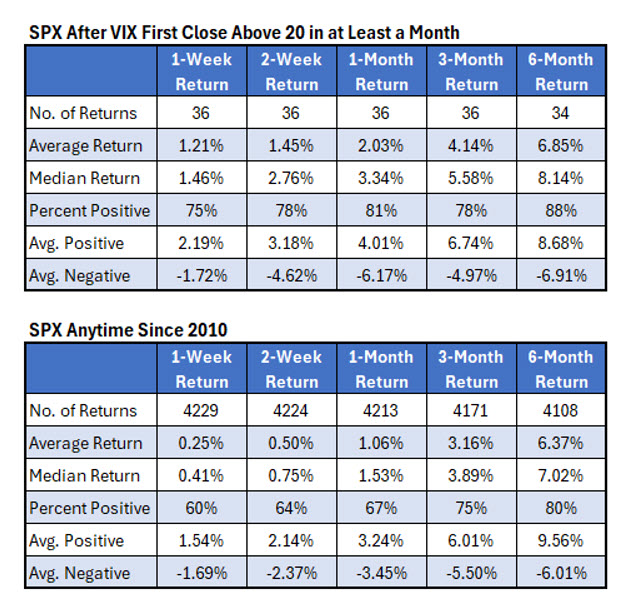
Using data since 2010, the table below summarizes how the SPX performed after the VIX closed above 20 for the first time in at least a month. This has been a buy signal for stocks, especially in the short term. The SPX averaged a return of about 2% with 81% of the returns positive in the month after a signal. Typically, the index returns just over 1% for a month with 67% of the returns positive.
There was also strong outperformance in the one and two-week time periods. The returns at the longer time frames are closer to typical market returns.
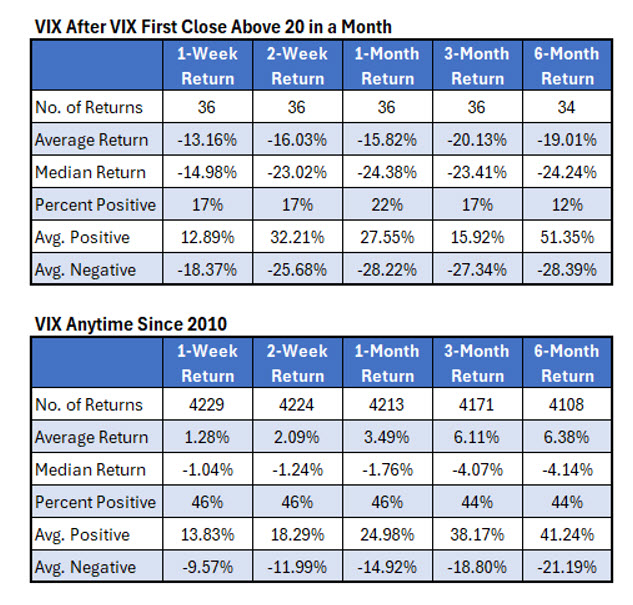
Given the SPX performed so well after a signal, it’s not a surprise to see the VIX averaged a significant drop after its move above 20. In the month after a signal, the VIX fell more than 15% on average, moving higher just 22% of the time. Compare that to an average VIX move of 3.5% in a month with 46% positive.
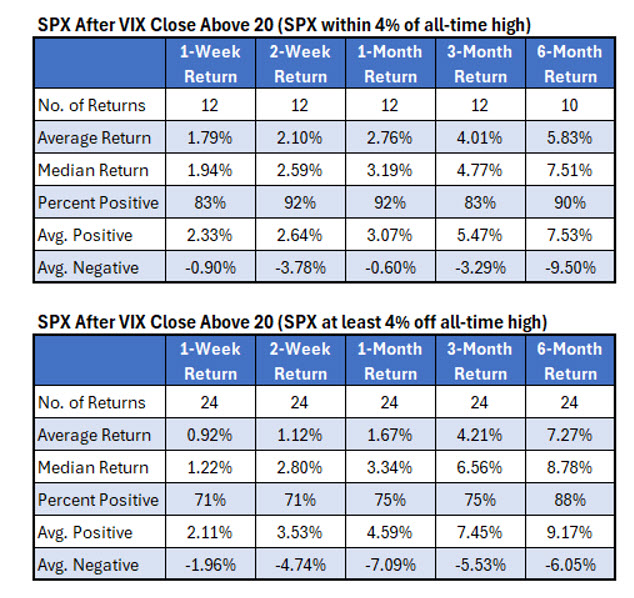
Next, I broke down the 36 prior signals by how close the SPX was to its all-time high. On Monday, when the VIX closed above 20, the SPX was about 3.5% off its high, which is relatively close. The first table below summarizes the SPX returns after a signal with the SPX within 4% of its high.
The short-term returns are even better in these instances with the SPX averaging a 2.76% return over the next month and 92% of the returns positive. After the other 24 signals, when the SPX was more than 4% off its high, the index averaged a return of 1.67% over the next month and 75% of the returns positive.
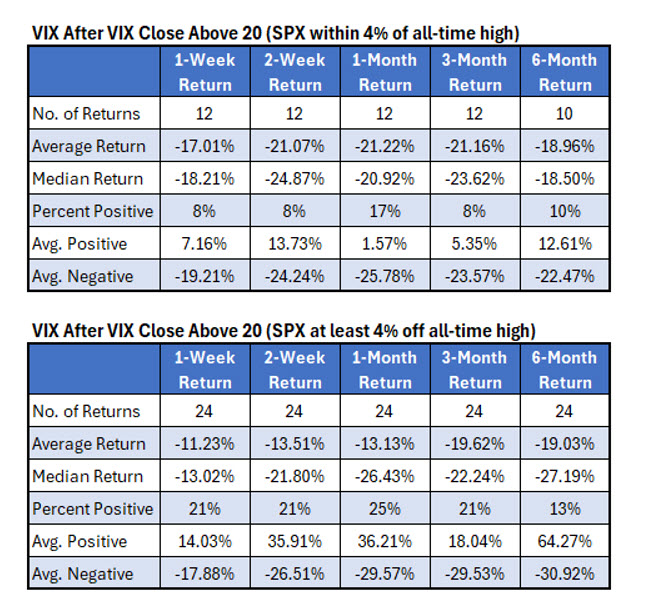
The VIX declined more than 20% on average after it closed above 20 for the first time in a month and the SPX was within 4% of its all-time high. After the other instances, it fell by 13% on average.
What are the Implications?
The VIX close above 20 for the first time since July shows investor’s willingness to pay up for portfolio protection. This has been a short-term buy signal since 2010. The SPX has tended to strongly outperform in the next week, two weeks, and month after similar signals. This was especially true when the signal occurred with the SPX this close to its all-time high.