
Negative headlines have done little technical damage, while subdued investor optimism leaves room for upside
“… there is plenty of caution surrounding the market. In fact, strategists at RBC Capital and Deutsche Bank joined J.P. Morgan, Citadel and Wells Fargo in cautioning investors, citing factors ranging from September seasonality -- even though September has had roughly a 50-50 chance of finishing higher since 2000 -- to the rate environment and the sustainability of the AI boom.”
-Monday Morning Outlook, September 14, 2026
Amid the caution Wall Street expressed toward the market early this month, one has to seriously wonder to what extent those fears have already been discounted into the market.
Consider that last week, the AI trade was threatened by Anthropic and OpenAI CEOs calling for an industrywide slowdown in artificial intelligence development, followed by a former Google DeepMind staffer writing that the technology will destroy humans. Strategists had warned about the sustainability of the AI boom earlier this month.
The rate environment worsened, which was another reason for caution among Wall Street strategists earlier this month, with the 10-year Treasury yield hitting 5%. Plus, to fight inflation, the Federal Reserve raised the fed funds rate for the first time in three years and cautioned traders that more hikes could be on the way.
One might assume that stocks sold off on the news. In fact, they did. But buyers quickly surfaced, and the S&P 500 Index (SPX – 7,650) closed just below the prior Friday’s close of 7,657. It was essentially a flat week amid the negative headlines.
“Unless and until there is notable technical deterioration in the market, such as a break below intermediate-term support at its 80-day moving average or the 7,530 level that essentially marked the top of the last range, I suspect patience will ultimately reward bulls.”
-Monday Morning Outlook, September 14, 2026
Strategists were correct about the potential for an AI slowdown or worsening rate environment. But last week’s headlines validating these concerns did not harm the market.
For example, last week’s SPX low was at the 7,530 level that I observed last week as a potential source of support. SPX 7,530 is 10% above its 2025 close and marked an area of profit-taking from May through July.
Plus, the index’s 80-day moving average, which was supportive in late July after a mild decline, again marked the trough last week. When all was said and done, the SPX closed just above the lower boundary of a range between 7,600 and 7,800 that has taken hold since early August.
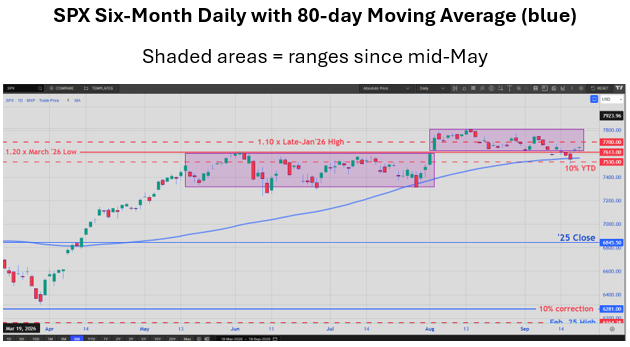
As mentioned last week, the April-May and early August action has defined the 2026 gain in the broader market. Take out these days or weeks, and the index has either traded below its 2025 close or sideways for much of this year. However, the fact of the matter is that the SPX reached a new closing all-time high a little over one month ago and is less than 2% below this closing high.
The price action described above -- in combination with the negative news flow for much of the year (conflict with Iran lasting longer than expected, higher oil prices, higher interest rates, inflation, AI uncertainty, valuations, national debt) -- has put investors and strategists on guard.
Some retail market participants are on guard, too, with last week’s American Association of Individual Investors (AAII) survey showing only 29% bulls, the lowest reading since early September 2025, when the bullish percentage was only 28% ahead of a 5.5% rally into late October.
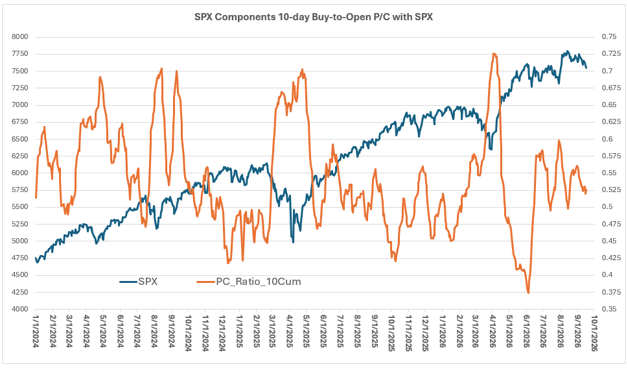
Equity option buyers on SPX components are not extremely pessimistic, but nor are they extremely optimistic, which is a bit surprising. Per the chart below, the 10-day buy-to-open put/call volume ratio is in the middle of extremes that suggest neither excessive optimism nor excessive pessimism. But, as a contrarian, I am leaning toward the “neutral” reading as having bullish implications, since the SPX is near an all-time high and has not incurred any serious technical deterioration.
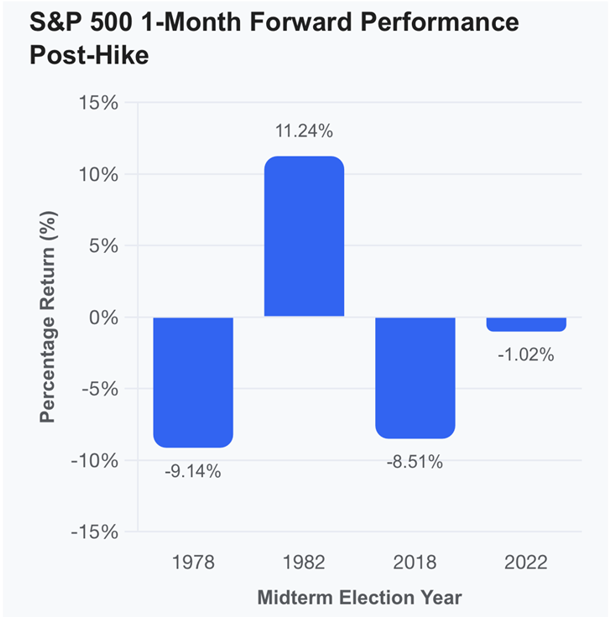
This isn’t to say there are no risks. For example, per the graph below, there have been four instances since 1978 in which the Fed raised interest rates just before the midterm elections, as it did last week.
The one-month forward performance resulted in losses three of those four times. But the loss was minute in one of those instances (2022), and the one time the SPX rallied, it did so by a double-digit percentage (1982).
With this statistic in mind, I continue to think that a hedge is warranted only if the SPX closes below its low from last week. If that happens, it doesn’t necessarily mean a correction is underway, but it does suggest that more ingredients are in place for a corrective move that supports a portfolio hedge.
Todd Salamone is Schaeffer's Senior V.P. of Research.
Continue reading: